Burnout Therapy for High Achievers & Professionals
You're still functioning. But it's costing you more than it used to.
My practice is currently full. I'm keeping a waitlist and will reach out personally as space opens.

You’re tired. Not “I need a good night’s sleep” tired. Not “this week has been a lot” tired.
The kind of tired that sits in your body and doesn’t fully lift even when you rest. The kind that makes you wonder if you used to have more energy or if you’re just remembering it wrong.
You’re still showing up. Still getting things done. Still being the person everyone relies on. But underneath all of that, something is running low, and you can feel it.
You took the vacation. You slept in. You told yourself things would feel different after the long weekend. They didn’t.
That’s not a rest problem. That’s burnout.

What Burnout Actually Looks Like
Burnout doesn’t always look like collapse. Most of the time it looks like someone who is still functioning, just increasingly hollowed out by the effort it takes.
You might recognize yourself here:
- You wake up already tired, before the day has even started
- Things that used to feel manageable now feel like too much
- You’re irritable or short-tempered with people you care about — and then guilty about it
- You’re going through the motions at work without feeling connected to any of it
- You want to rest but don’t actually know how to slow down
- You’ve lost interest in things that used to matter to you
- You feel like you’re behind, even when you’re objectively keeping up
The World Health Organization recognizes burnout as a real occupational phenomenon with genuine physiological consequences. It’s not weakness. It’s what happens when a nervous system has been running on pressure and obligation for too long without adequate recovery.
Why Rest Isn't Fixing It
You’ve probably already tried the obvious things. A weekend off. More sleep. A vacation. Telling yourself to slow down.
And it helped… briefly. Then you came back to the same exhaustion.
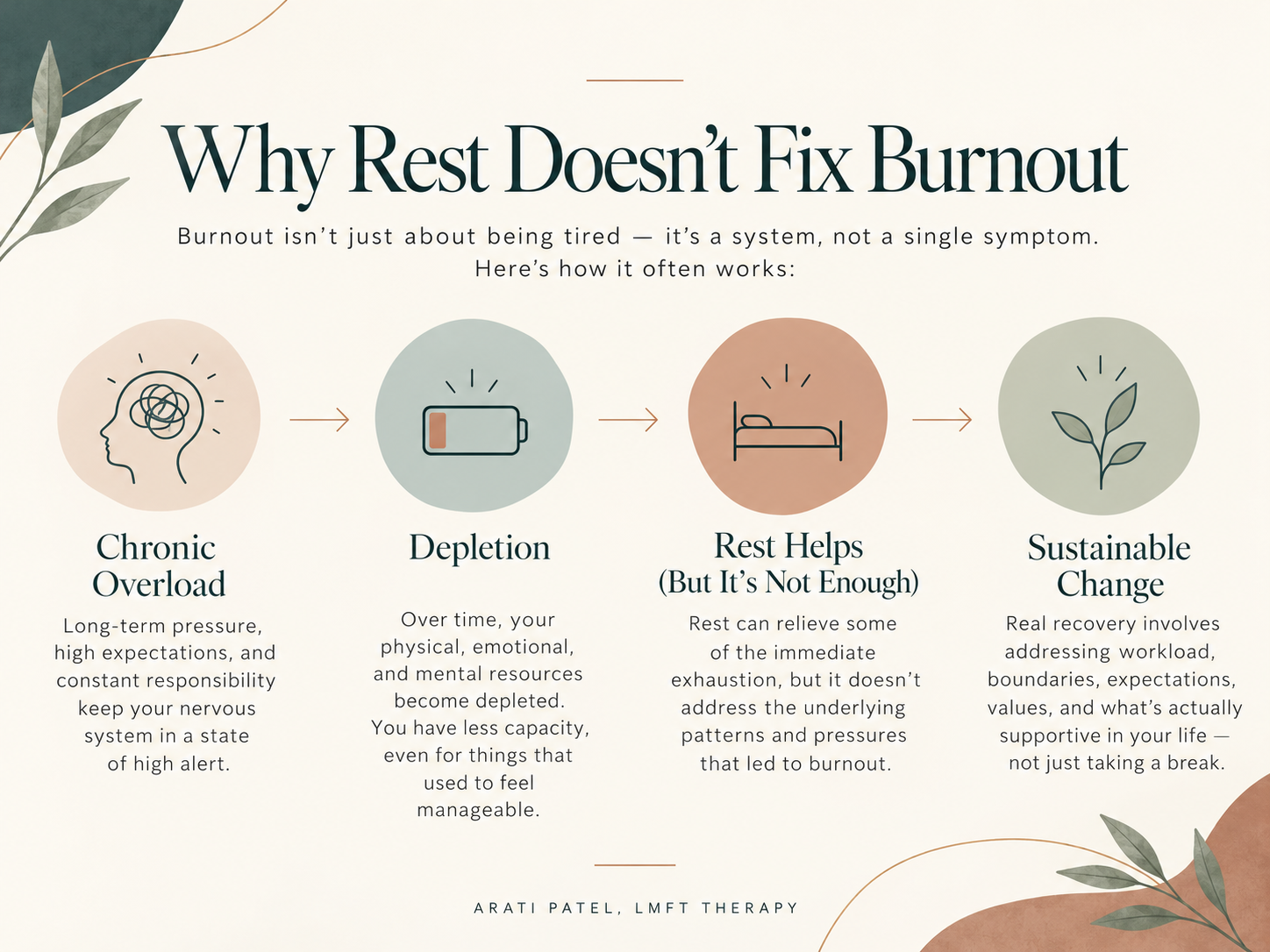
That’s because burnout isn’t a rest deficit. It’s a nervous system problem. When your system has been in overdrive long enough, it stops knowing how to come out of it. Rest helps with tiredness. It doesn’t reset a nervous system that’s forgotten what safe feels like.
That’s the work we do in therapy, not just clearing your schedule, but actually teaching your nervous system that it’s okay to stop.
What's Usually Underneath Burnout
For most high-achieving clients, burnout isn’t random. It’s the end result of a specific set of patterns that have been running for a long time.
Perfectionism — the standard that’s never quite met, the task that’s never quite finished. When everything has to be done right, nothing is ever fully done.
People-pleasing — saying yes when you mean no, absorbing everyone else’s needs, not asking for help because you don’t want to be a burden. It’s exhausting in ways that don’t show up on any to-do list.
Chronic over-responsibility — being the one who holds everything together at work, at home, in your family. There’s no off-the-clock when you’re always the person who handles it.
Anxiety — the background hum of what could go wrong that keeps your nervous system in low-grade threat mode even when nothing is actually wrong.
These patterns don’t respond to a long weekend. They need something more direct. Learn more about how anxiety, perfectionism, and burnout connect →
Why It's So Hard to Stop
Because stopping doesn’t feel neutral. It feels uncomfortable, unproductive, and sometimes even dangerous, especially if you’ve spent years being the reliable one, the responsible one, the one who doesn’t complain.
When rest has to be earned, you never quite earn it enough. When your worth is tied to your output, slowing down feels like evidence of something going wrong.
So even when you’re depleted, something in you keeps going. Not because you want to. Because stopping feels worse.
This is exactly what we work on in therapy, not just the exhaustion, but the internal system that keeps generating it.
A Note for South Asian and First-Generation Clients
For many South Asian and first-generation clients, burnout isn’t just about work. It’s about a lifetime of being the person everyone depends on: carrying family expectations, cultural responsibility, and the pressure to make your parents’ sacrifice worth it, often with very little room to fall apart yourself.
You may have been taught that pushing through is what good people do. That complaining is ungrateful. That rest is a luxury you haven’t quite earned yet. Those messages don’t disappear just because you’re now an adult who knows better.
Burnout in this context isn’t a personal failure. It’s what happens when you carry too much for too long with no one asking if you’re okay. Learn more about South Asian therapy →
Navigating burnout as a South Asian professional specifically? This page goes deeper →

What We Work On Together
Burnout therapy isn’t about doing less. It’s about changing your relationship to pressure so it stops costing you so much.
What that actually looks like:
- Regulating your nervous system so your body can genuinely recover — not just your schedule
- Understanding the internal patterns keeping you in overdrive even when the external demands ease up
- Building real tolerance for rest without the guilt arriving twenty minutes in
- Learning to say no in ways that feel sustainable rather than catastrophic
- Reconnecting with what actually matters to you, separate from what you feel obligated to produce
- Working with the part of you that believes stopping means failing
The goal isn’t a life with less ambition. It’s a life where ambition doesn’t come at the cost of everything else.

About Arati Patel, LMFT
I’m Arati Patel, a licensed Marriage and Family Therapist in California, Illinois, and New York, in practice since 2013. I specialize in burnout, high-functioning anxiety, and perfectionism, the kind that builds slowly and quietly until one day your body just stops bouncing back the way it used to.
My approach is mindfulness-based and depth-oriented, drawing from IFS-informed therapy, nervous system regulation, somatic awareness, and Buddhist and yoga psychology. We don’t just manage burnout, we understand what’s driving it and work on that directly.
I’ve navigated my own version of this. I know what it’s like to keep going long past the point where you should have stopped. That experience is part of how I work.
Licenses: California LMFT #105734 · Illinois LMFT #166.001662 · New York LMFT #002678
Featured in Time Magazine, AskMen, The Good Trade, Nice News, The Juggernaut, Inspired by This, Her Agenda, and Mindless Labs
“I used to think exhaustion was just the price of being successful. Therapy helped me realize how much of my life was being driven by fear instead of actual intention.”
— Client (shared with permission)
What Changes
Therapy doesn’t make life easier. It changes your relationship to it entirely.
Clients describe things like: having more energy without pushing themselves harder. Finishing the workday and actually leaving it behind. Resting on a Sunday without the guilt arriving by 2pm. Feeling present with the people they love instead of distracted by everything still on the list.
Not because they stopped caring. Because they stopped running on fumes and calling it normal.
Frequently Asked Questions About Burnout Therapy
You Don't Have to Keep Pushing Through.
You don't need to have everything figured out before reaching out. A free 15-minute consultation is a chance to share what you're looking for, ask questions, and see whether working together feels right.
IN-PERSON IN VENTURA, CA · ONLINE THROUGHOUT CA, IL & NY