Anxiety Therapy for Overachievers & Professionals
Your Mind Never Really Turns Off. Even When Everything Is Fine.
My practice is currently full. I'm keeping a waitlist and will reach out personally as space opens.

You don’t look anxious. You look like someone who has it together, because you do, on the outside. You show up, you deliver, you’re the person everyone counts on.
Inside, your mind is replaying a conversation from three days ago. It’s running the worst-case version of tomorrow. It’s questioning whether you said the right thing, handled it well enough, did enough. Even when nothing is actually wrong, your body hasn’t gotten the memo.
You’re not falling apart. But you’re also not at ease. And you’ve been white-knuckling it for long enough that you’ve started to wonder if this is just how you are.
It isn’t. It’s a pattern. And patterns can change.

What High-Functioning Anxiety Actually Looks Like
High-functioning anxiety doesn’t look like panic. It looks like being the most capable person in the room while quietly running on fumes, competent on the outside, relentless on the inside.
You might recognize yourself here:
- You replay conversations long after they’re over, dissecting what you said and what you should have said instead
- You overanalyze decisions that were objectively fine
- You can’t fully relax even when you have time, rest feels vaguely unearned or unsafe
- You lie awake running through tomorrow’s to-do list or rehashing something from last week
- There’s a low-level tension in your body that never quite disappears
- You feel “on” all the time: prepared, vigilant, braced for something to go wrong
- You’re functioning well by every external measure and exhausted by every internal one
Not sure if this is anxiety or just how you’re wired? Take the free Anxiety Quiz – it takes two minutes and gives you real clarity.
This Isn't Just Stress. It's a Pattern.
Most clients with high-functioning anxiety say some version of the same thing in our first session: “I’ve just always been like this.”
Always thinking. Always anticipating. Always a little on edge, even when life is objectively fine.
Here’s the thing: that’s not your personality. That’s a pattern your nervous system learned, usually a long time ago, usually for good reasons. It was useful once. It kept you safe, kept you prepared, kept you one step ahead of whatever might go wrong. It just doesn’t have an off switch.
Why You Can't Think Your Way Out of It
You’ve probably already tried the logical approaches. You’ve journaled. You’ve read about anxiety. You’ve told yourself to stop overthinking approximately ten thousand times. You understand your patterns intellectually.
And you’re still anxious.
That’s because anxiety doesn’t live only in your thoughts. It lives in your nervous system. Understanding it is a good start, it’s just not enough on its own. Therapy works because we go underneath the thoughts to the patterns generating them, and we work with your nervous system directly, not just your mind.
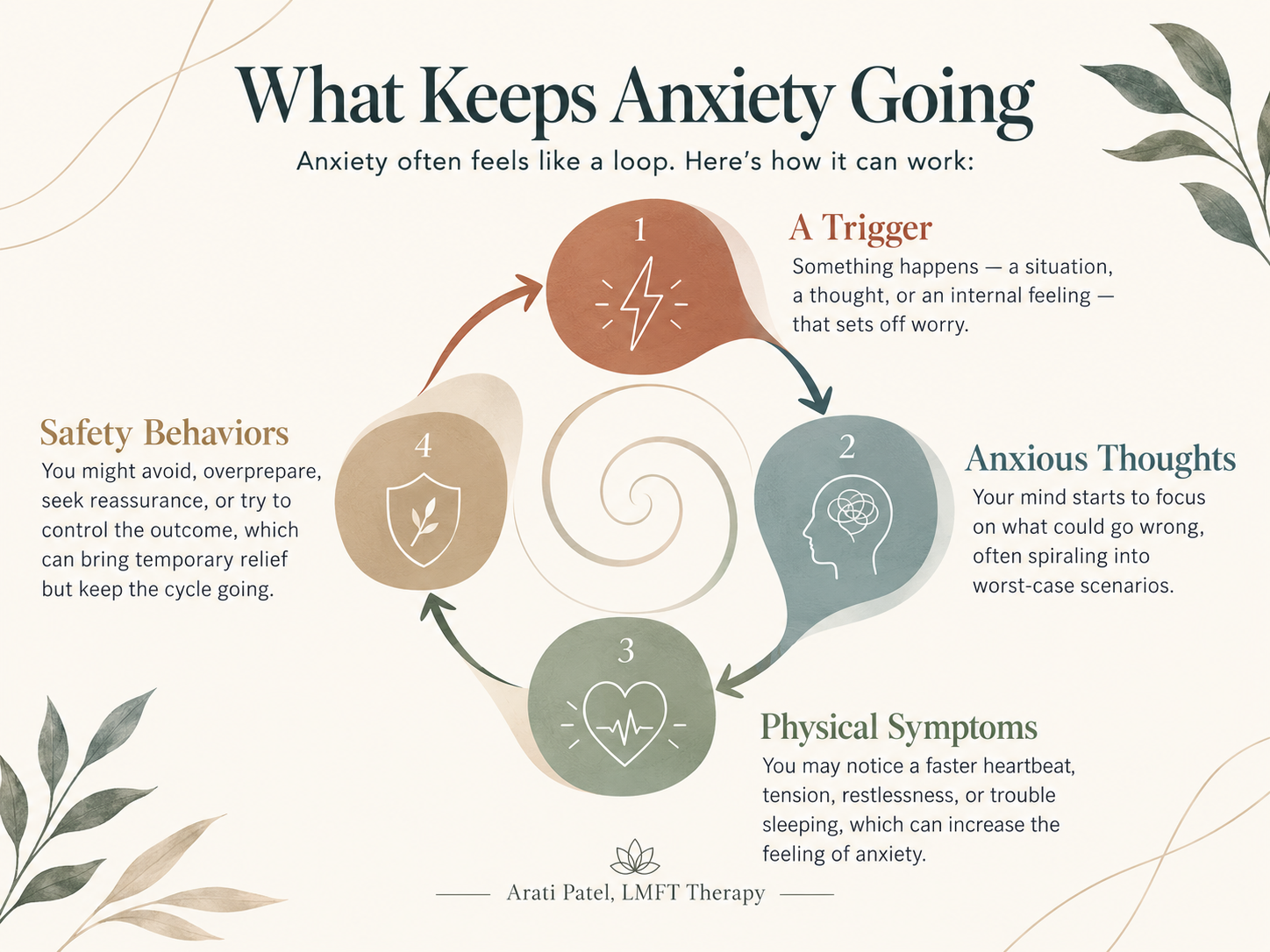
A Trigger
Something happens — a situation, a thought, or an internal feeling — that sets off worry.
What's Usually Underneath High-Functioning Anxiety
For most of my clients, anxiety isn’t random. It’s connected to a specific way of moving through the world that developed for good reasons and now runs automatically.
Perfectionism — if everything is perfect, nothing bad can happen. The anxiety gives the perfectionism a job, and the perfectionism keeps the anxiety fed.
People-pleasing — when your sense of safety depends on other people’s approval, you’re in a constant low-grade threat state. Scanning for disapproval. Bracing for conflict. Working overtime to stay liked.
Chronic over-responsibility — being the one who holds everything together means you can never fully put it down. There’s no off-the-clock when you’re always the person who handles it.
Fear of failure or disappointment — often rooted in early experiences where performance felt tied to love, belonging, or safety. The stakes still feel just as high even when, logically, they aren’t.
These patterns don’t travel alone. Anxiety, perfectionism, and burnout tend to reinforce each other — which is why we often work on all three together.
A Note for South Asian and First-Generation Clients
For many South Asian and first-generation clients, anxiety isn’t just internal, it’s shaped by an entire context. The weight of expectations that were never spoken out loud. The responsibility handed to you before you could name it. Being the one who had to get it right, for everyone, without burdening anyone in the process.
You may have learned early to keep things to yourself, to push through instead of slow down, to manage everyone else’s feelings before your own. That’s not a character trait, that’s a survival strategy. And it shapes how anxiety shows up, and how we work with it.
Learn more about South Asian therapy →
If you’re a South Asian professional specifically, this page goes deeper into that experience →
What We Work On Together
Therapy for high-functioning anxiety isn’t about forcing your mind to be quiet or becoming someone who stops caring. It’s about changing your relationship to what’s happening internally so you’re not at the mercy of it.
What that actually looks like in practice:
- Calming your nervous system so your body can actually believe things are okay, not just your mind
- Understanding the patterns underneath your overthinking rather than just managing the symptoms
- Working with the inner critic and the part of you that can never quite trust that things are fine
- Building genuine confidence in your own judgment without needing constant external validation
- Learning to feel grounded even when things are uncertain or unresolved
- Moving through hard conversations and decisions without days of anticipatory dread
The goal isn’t a life without anxiety. It’s a life where anxiety isn’t running the show.

About Arati Patel, LMFT
I’m Arati Patel, a licensed Marriage and Family Therapist in California, Illinois, and New York, in practice since 2013. I specialize in high-functioning anxiety, perfectionism, and burnout — the kind that hides behind competence and doesn’t announce itself until you’re completely depleted.
My approach is mindfulness-based and depth-oriented, drawing from IFS-informed therapy, nervous system regulation, somatic awareness, Buddhist and yoga psychology, and over 20 years of personal practice. Sessions are honest and direct. We don’t just build coping strategies — we work on what’s actually generating the anxiety in the first place.
I’ve also been there myself. I know what it’s like when your mind won’t slow down and rest feels like something you haven’t quite earned yet. That lived experience shapes everything about how I work.
- California License #105734
- Illinois License #166.001662
- New York License #002678
Featured in Time Magazine, AskMen, The Good Trade, Nice News, The Juggernaut, Inspired by This, Her Agenda, and Mindless Labs
“When I first started therapy with Arati, I felt lost, heartbroken, and unsure how to manage my emotions. With her support, I learned how to sit with my feelings, set limits, and start choosing myself. I’ve created a life that feels calmer, more connected, and more true to who I am.”
— Former client (shared with permission)
What Changes
Therapy doesn’t make life perfect. It changes your relationship to it entirely.
Clients describe things like: their mind finally slowing down at the end of the day. Making a decision and actually trusting it. Sleeping through the night without the 3am spiral. Feeling present with the people they love instead of half-distracted by whatever’s next. Waking up without that low-grade dread that’s been there so long it started to feel normal.
Not because life got easier. Because it stopped feeling like everything is on the line all the time.
Frequently Asked Questions About High-Functioning Anxiety Therapy
From the Blog
Ready to Spend Less Time in Your Head?
You don't need to have everything figured out before reaching out. A free 15-minute consultation is a chance to share what you're looking for, ask questions, and see whether working together feels right.
IN-PERSON IN VENTURA, CA · ONLINE THROUGHOUT CA, IL & NY